For years, a familiar critique has shadowed one of the most robust findings in economics: people with more education earn more.
Yes – but is it causal?
Do schools actually raise earnings? Or are more able, more motivated individuals simply more likely to stay in school?
In a new paper with George Psacharopoulos, published in the International Journal of Educational Development, we revisit this question using the best available global evidence. The conclusion is unambiguous: Education raises earnings – and the effect is large.
The core result: 10% per year
We compile 191 estimates from 145 studies across 54 countries, focusing on quasi-experimental research designs that isolate causal effects. Across this global evidence base, the finding is strikingly consistent: An additional year of schooling increases earnings by about 10 percent.
This aligns with decades of research – but now rests on stronger causal foundations. For policymakers, this matters. It means education is not just correlated with growth – it drives it.
A surprising pattern: causal estimates are often higher
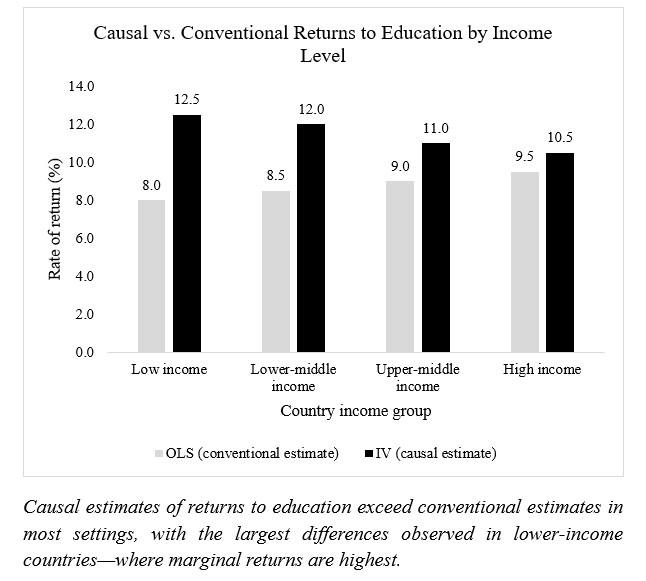
One of the most interesting findings is methodological. In about 80 percent of cases, causal estimates (instrumental variables, or IV) exceed conventional OLS estimates. This runs counter to a common assumption that standard estimates overstate returns due to selection bias. Why does this happen?
Causal methods identify the impact of schooling for individuals whose education decisions are influenced by policy – such as compulsory schooling laws, school construction, or financial support. These individuals are not random. They are typically constrained learners:
• Students from low-income families
• Those in rural or underserved areas
• Individuals on the margin of dropping out
And for them, the payoff to education is especially high.
Where returns are highest: the development gradient
The data also reveal a clear global pattern. The gap between causal (IV) and conventional (OLS) estimates is largest in low- and middle-income countries.
This reflects a simple economic reality. The return to an additional year of schooling is highest where education is least accessible.
The implication is direct: expanding access in lower-income settings is not just socially desirable; it is high-return economic policy.
Education expansions disproportionately benefit those who would otherwise be excluded. As access increases, the new entrants are typically individuals facing financial, geographic, or institutional constraints; and they experience the largest gains. This promotes both efficiency (higher aggregate earnings) and equity (greater gains for disadvantaged groups). Few policy interventions achieve both simultaneously. Education does.
Policy implications
The policy message is clear. First, the causality debate is largely settled: education increases earnings. Second, the highest returns come from bringing new learners into the system, including low-income students, rural populations, and first-generation learners. Third, completion maters. Returns depend on progression through key levels, especially secondary and tertiary education.
Finally, education should be understood as core economic policy. By raising skills and productivity, it drives job creation, higher wages, and long-term growth.
After decades of research, using the best causal evidence available, the conclusion is straightforward. Education is one of the highest-return investments societies can make—especially when it reaches those who need it most.
Reference
Patrinos, H.A., & Psacharopoulos, G. (2026). Causal returns to education. International Journal of Educational Development, 122.
DOI: https://doi.org/10.1016/j.ijedudev.2026.103565
 Education, economics and public policy