Why Learning—Not Just Schooling—Drives Economic Returns*
— Originally published on Substack
We know education pays—but what if how much you learn matters more than how long you stay in school?
For decades, researchers have measured the value of education by counting years spent in the classroom. But education isn’t just about time—it’s about outcomes. A growing body of research shows that the quality of schooling, captured by what students actually learn, is just as important—if not more than simply staying in school longer.
In our working paper, we summarize what the latest research says about the effect of raising school quality—typically measured by student test scores—on future earnings. Drawing from over 70 studies in 40 countries, we show why learning matters and how investing in quality education yields major payoffs for individuals and economies alike.
Learning AND Schooling
Most studies on the returns to education focus on the extensive margin: how many years of education a person has. But research on the intensive margin—the quality of education or the skills gained—is relatively rare. Why? Because it’s hard to measure learning, and harder still to track its impact over time.
But when we do have the data, the results are striking. From regression discontinuity studies in selective schools to natural experiments using military enlistment data in Sweden, and cognitive test data from twins, researchers have found consistent links between better learning outcomes and higher earnings later in life.
One compelling example: in Chile, when adult literacy was included in earnings models, the estimated return to schooling dropped by 27%. But a one standard deviation increase in literacy was associated with a 20% rise in wages. Skills, it turns out, matter more than seat time.
How Much Does Learning Increase Earnings?
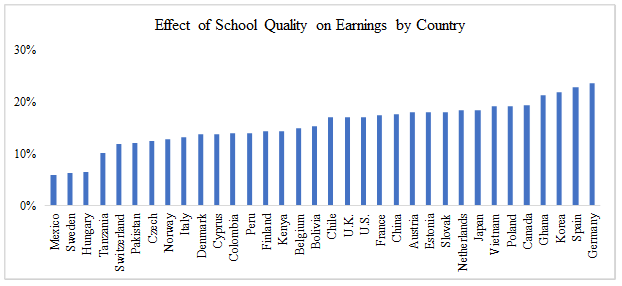
Based on 72 estimates from studies across the globe, a one standard deviation increase in test scores is linked to a 15% boost in earnings. The effect is remarkably consistent across high-income and middle-income countries—hovering around 16%.
For context, the global average return to an additional year of schooling is about 10%. Learning gains may offer even greater economic rewards than additional schooling itself.
What’s more, these effects are especially powerful when school systems target quality improvements at the margins—those most likely to benefit from better instruction or new learning tools. In other words, raising test scores isn’t just a luxury for wealthy countries—it’s a smart investment everywhere.
What Does It Cost to Improve Quality?
If better learning leads to better wages, shouldn’t we be investing more in school quality? Absolutely—but we also need to factor in the cost of raising learning outcomes.
Unlike the opportunity cost of staying in school longer (foregone wages), improving school quality involves investments in things like better textbooks, teacher training, technology, and information.
Some interventions are more cost-effective than others. For example, structured pedagogy programs—combinations of aligned curricula, teacher guides, and coaching—consistently deliver high learning gains per dollar spent. Similarly, Teaching at the Right Level (TaRL) approaches, which tailor lessons to a student’s actual proficiency rather than their age, show high returns.
In low- and middle-income countries, some of these “best buys” have benefit-cost ratios as high as 65:1—among the most effective investments available in any sector.
A Real-World Example: Mississippi’s Literacy Leap
Even in high-income settings, investments in learning quality pay off. Mississippi’s early literacy initiative, for example, led to gains of up to 0.29 standard deviations in reading and math scores. That’s equivalent to an extra 0.25 years of schooling—translating to an annual wage increase of about $1,017 per student.
The kicker? This program costs just $32 per student per year, or 0.2% of the state budget. Its internal rate of return? 22%. This is the kind of math that should make policymakers take notice.
What Should We Do?
The takeaway is clear: learning outcomes drive long-term earnings. While years of schooling are important, what students learn may be even more valuable.
Improving school quality isn’t just about equity or social progress—it’s also a sound economic strategy. The data shows that investing in learning yields strong private and social returns, especially when interventions are evidence-based and cost-effective.
Going forward, education systems should focus not only on expanding access, but on ensuring that access leads to meaningful learning. That means:
- Tracking learning outcomes consistently
- Prioritizing programs that have proven to work
- Investing where gains are largest: among low-performing students
- Measuring success not only by enrollment, but by what students know and can do
As we shift our focus from schooling to learning, we unlock a future where education truly delivers on its promise.
* Written with George Psacharopoulos, a leading researcher on the economics of education and former World Bank and London School of Economics.

 Education, economics and public policy