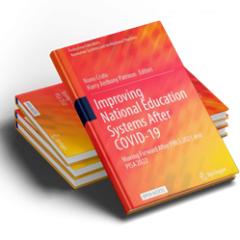
Put Education and Skills at The Centre of All Policies | (News and Research 374)
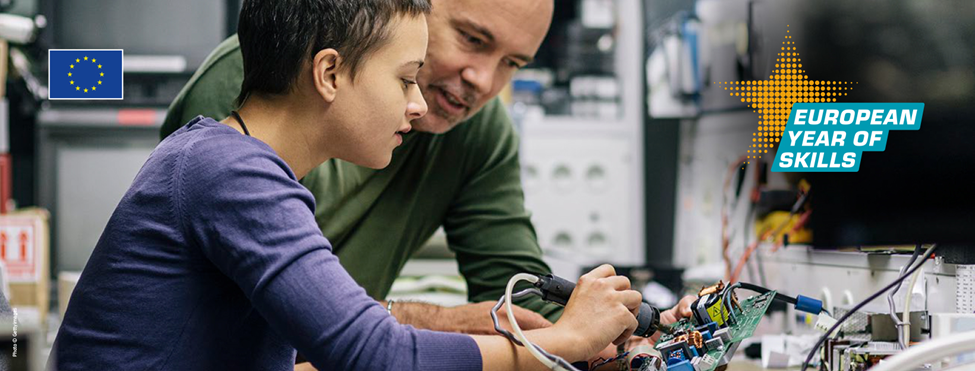
European Year of Skills 2024. “The main driver of sustainable economic growth is skills, especially digital, green and transversal skills ahead of the twin transition…Research shows that the private average global rate of return to one extra year of schooling is about nine percent a year and very stable over decades: Private returns to higher education have increased over time, raising issues of financing and equity. Social returns to schooling remain high, above 10 percent at the secondary and higher education levels.”
Foundational skills: Building blocks of success in the 21st century | de Hoyos | Foundational skills such as numeracy and literacy are and will remain relevant throughout the 21st century. By prioritizing 21st-century skills, education systems implicitly assumed that the core skills of numeracy and literacy were either already universal or no longer relevant. However, foundational skills such as numeracy and literacy are and will remain relevant throughout the 21st Century. Worryingly, over half of all students in low and middle-income countries, most from disadvantaged backgrounds, cannot read and understand a simple story or know how to use basic math operations to solve everyday problems by the end of primary school.
Closing the gap: Effect of a gender quota on women’s access to education in Afghanistan | Najam | Affirmative action is a promising solution to the crucial challenge of bridging the gap in women’s access to higher education in low- and middle-income countries (LMICs). I use public universities’ matriculation data from 2013–2018 and difference-in-differences estimators to examine the causal impact of a gender quota on women’s educational opportunities in Afghanistan. The quota increased the proportion of women in the treated concentration group by nine percentage points and the share of women from low socio-economic status by three percentage points. The expansion was associated with a 0.04-unit decline in the average score ratio of female-to-male applicants, driven by a reduction in the score threshold needed for women’s admission. The effects were condensed in competitive concentrations, where the overall share of women and women with low SES increased by 17 and four percentage points, respectively. The findings suggest that affirmative action is a viable option for addressing the gender gap in fragile settings.
Fixing the Foundation: Teachers and Basic Education in East Asia and Pacific | More than half of 10-year-olds in most middle-income East Asia and Pacific countries are unable to read and understand an age-appropriate text. Strong skills cannot be built on weak foundations. And weak skills will not power the productivity growth needed for the transition to high-income status. Empowering teachers, through a combination of training and technology, is key to strengthening basic learning outcomes.
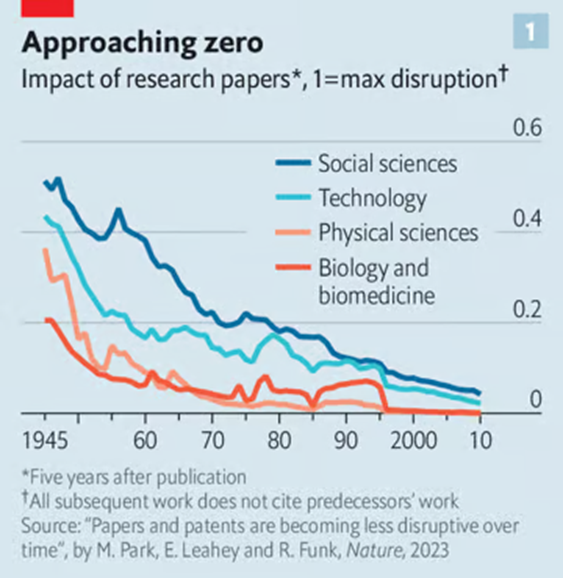
Universities have boomed in recent decades. Higher-education institutions across the world now employ in the order of 15m researchers, up from 4m in 1980…In practice, however, the great expansion of higher education has coincided with a productivity slowdown. Whereas in the 1950s and 1960s workers’ output per hour across the rich world rose by 4% a year, in the decade before the covid-19 pandemic 1% a year was the norm.
Parents’ lawsuit forces California to spend $2 billion on learning loss | California schools will have to spend $2 billion of their remaining Covid relief funds on tutoring and other measures to help high-needs students recover from learning loss, according to a legal settlement announced this week. The agreement, reached in Alameda County Superior Court, was between the state and a group of families in Oakland and Los Angeles who said their children fell calamitously behind during remote learning. Public Counsel, a nonprofit advocacy law firm, and Morrison Foerster represented the plaintiffs. “This should have an enormous impact for students across California,” said Amanda Mangaser Savage, an attorney at Public Counsel who worked on the case. “It truly will make California’s education system more equitable for students who’ve been left behind.”
Pandemic learning losses COVID-19, School Closures, and Student Learning Outcomes New Global Evidence from PISA in the news:
COVID-19 school closures led to significant learning losses, says World Bank expert

School closures during the first wave of COVID-19 lockdowns inflicted significant learning losses on students. Younger students and those from disadvantaged backgrounds are experiencing the greatest setbacks, compromising their educational trajectory and future opportunities. This was according to World Bank Senior Adviser for Education Harry Patrinos who presented his study findings during a knowledge-sharing session at the Philippine Institute for Development Studies (PIDS). His study highlighted that the longer schools remained closed, the greater the learning loss. “For every week of closure, learning levels decline by almost 1 percent,” Patrinos said. “Twenty weeks closed translates to losing almost a year’s worth of learning,” he explained…and watch the recorded session here: https://youtu.be/NpSK2fqDGL0.
COVID-19 lockdowns linked to ‘learning losses’ (Inquirer)
The Pandemic’s Hidden Victims: Our Children’s Education (BNN)
Pandemic learning setbacks reckoned at 1% per week of lost in-person classes (BusinessWorld)
COVID-19 lockdowns linked to ‘learning losses’ (PhilanthropyNews)
 Education, economics and public policy