
Demographic Changes and Fiscal Constraints Threaten the Future of Education in Low-Income Countries | (News and Research 367)
Demographic Changes and Fiscal Constraints Threaten the Future of Education in Low-Income Countries | A new World Bank-UNESCO report shows that a projected increase of the school age population in Africa will strain government financing for education and threaten countries’ ability to provide quality education for children and youth. In contrast, in other countries, particularly in Asia, declining school-age populations will free up financing for education.

Education Finance Watch 2023 (EFW), an annual report on the global state of education financing jointly produced by the World Bank, the Global Education Monitoring (GEM) Report, and the UNESCO Institute for Statistics (UIS), explores the challenges of demographic changes on education financing and learning outcomes. It shows that government education spending has not kept pace with the need to address post-COVID-19 learning losses and that development assistance to education has fallen.
“The magnifying glass consistently falls on sub-Saharan Africa,” says Luis Benveniste, Global Director for Education, World Bank. “We do not need to wait for any further cues to step up our financial support to the region in the remaining years to 2030 so that education opportunities there do not backslide. Progress is inclusive or it is incomplete. The future we envision for 2030 must encompass the entire world, leaving no one behind.”
Highlights:
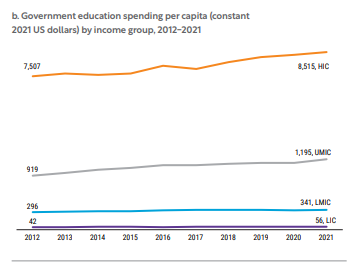
- The average education investment per student in the richest countries (United States at $11,655) is 13 times the education spending in middle-income countries ($890) and 200 times the spending in low-income countries ($56).
- Official development assistance, an important funding source for education for low-income countries, fell by 7 percent from 2020 to 2021. Development assistance represents 13 percent of total education funding in low-income countries.
- The good news? Countries with lower education spending and efficiency are expected to see the largest learning gains from increased education financing.
“In all countries, particularly those with relatively lower income, the level, efficiency, and equity of education spending is often inadequate to reach learning goals,” says Harry Patrinos, Senior Adviser in the World Bank’s Education Global Practice. “However, more money will not fully solve this.”
“When we are talking about all these multiple crises, this [education] is a crisis that we can manage, if we have enough political will to stay focused and the willingness to pay for it, and that is because we owe these children,” said World Bank Senior Managing Director Axel van Trotsenburg.
World Bank Chief Economist Indermit Gill stressed that, “A scandalous imbalance exists in levels of government spending on education across the world: the richest countries spend more than $8,000 per student per year. The poorest manage just $54.”
The Minister of National Education, Preschool and Sports for Morocco, Chakib Benmoussa, emphasized that, “transforming education requires additional funding and resources, but they need to be allocated to what really makes a difference.”
While Seedy Keita, Minister of Finance and Economic Affairs, The Gambia, said that “Investment in education is investment in long-term human capacity. We feel it is a national duty to invest in education, and we will see the future dividends of these returns.”
World Bank Vice President for Human Development Mamta Murthi: “The quality of education that students receive in many low- and middle-income countries remains poor. And too many children are out of school. We are working with all partners to help governments in spending enough money on education and spending it well – so that funding goes to the right interventions and to the students most in need.”
Education Finance Watch: Report | Flyer
Brief: Education Finance: Using Money Effectively is Critical to Improving Education
 Education, economics and public policy