An Investment in Knowledge Pays the Best Interest | (News and Research 366)
Lessons from an international school report | FT |Benjamin Franklin was not known for his financial advice. But America’s founding father is widely quoted as having proclaimed: “An investment in knowledge pays the best interest.” More than 200 years later, this wisdom still holds true. One extra year of schooling amounts to an annual rate of return of 9 per cent for the individual, according to a recent World Bank study. For measure, that is greater than the annualized price return of the S&P 500 over the past half century. Education additionally drives untold gains for society and the economy too (link to World Bank study here and here).
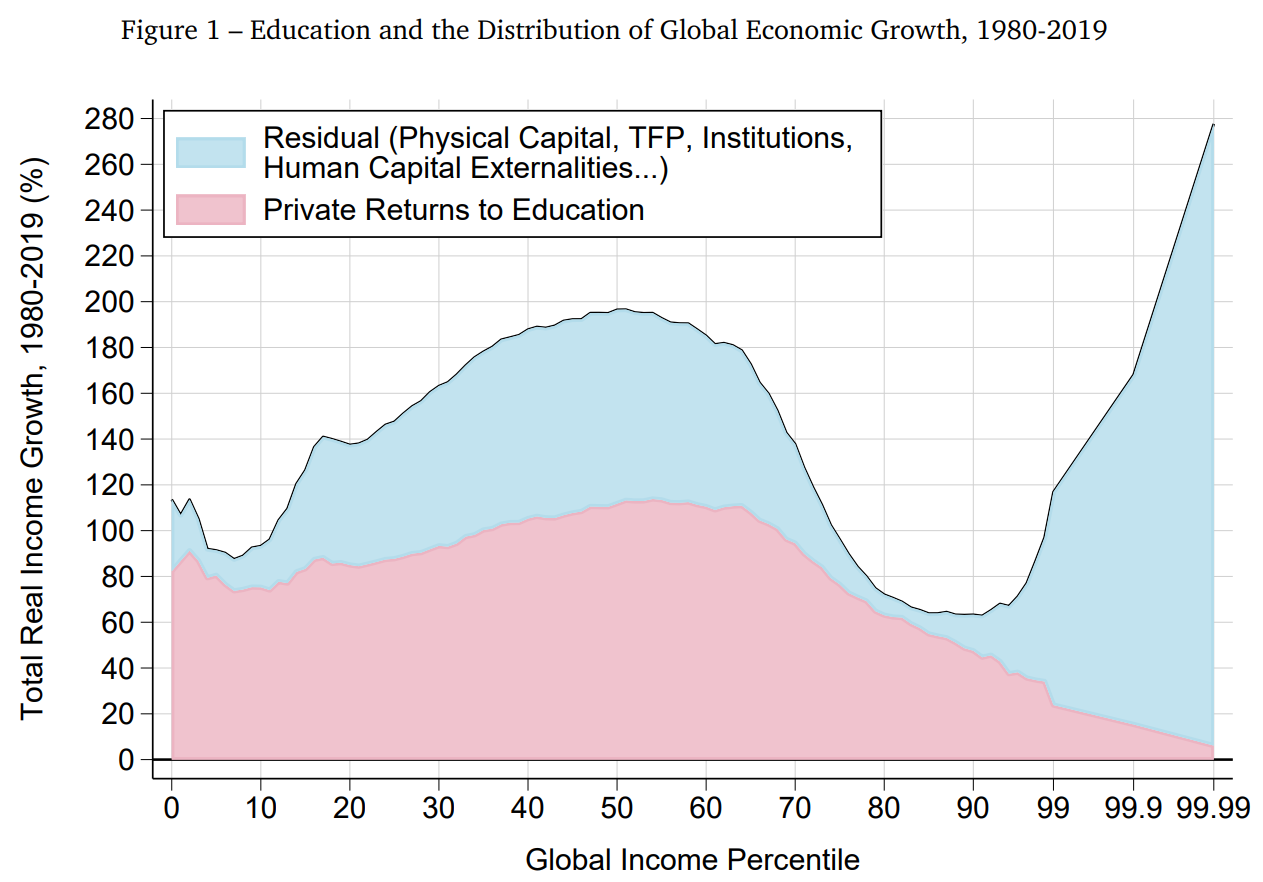
Education At the Centre of Global Poverty Reduction | Gethin |Access to schooling has improved dramatically around the world in recent decades. How useful have these investments been in reducing poverty and gender inequality? The first estimates of the aggregate and distributional effects of global education expansion since 1980 are provided by leveraging a unique database representative of 95% of the world’s population, a distributional growth accounting framework that identifies the effects of schooling on growth and inequality, and complementary evidence from three large-scale schooling expansion policies: education accounts for at least 50% of global economic growth, 70% of growth among the world’s poorest, and 50% of the reduction in global gender inequality since 1980.

The Economist on PISA 2022 and the impact of school closures during COVID-19: “As a rule of thumb, every extra year of schooling a child receives pushes up their annual salary by close to 10%. Lost learning could still be holding wages down years from now.”
Education: Why not a race to the top? | Leonardo Garnier (Special Adviser to the UN Secretary General on Transforming Education) | Education is critical for future growth and material well-being, but educational investment remains insufficient and highly unequal. “It´s been 50 years since the publication of Psacharopoulos and Hinchliffe (1973) seminal book Returns to Education: An International Comparison, where they rigorously demonstrated what most teachers and educators already knew both from intuition and from experience: while education is much more than just an economic investment, the fact is that, in simple economic terms, education pays. Five decades of research – and the experience of many countries – have confirmed this time and again: investing in education is one of the best, if not the best investment a country can make to increase income and improve the material wellbeing of its population. And yet, paradoxically, we are far from investing enough in education.
On measuring learning outcomes and the SDGs
- Statement on the downgrade of SDG 4.1.1a to a Tier 2 indicator | The Global Coalition for Foundational Learning is concerned by the downgrading of the Sustainable Development Goal (SDG) 4.1.1a indicator, the proportion of children and young people in grades 2/3 achieving at least a minimum proficiency level in reading and mathematics, from a Tier 1 to a Tier 2 indicator.
- An entitlement to learning assessment support | Montoya, Crouch | This blog proposes a fund to help low- and lower-middle-income countries finance the cost of learning assessment in a sustainable way.
- The foundational learning data challenge: A civil society view from the Global South | Fiszbein, Bhattacharjea
- Saving SDG 4.1.1a | Crawfurd, Le, Sandefur
 Education, economics and public policy