Teacher Policy, Mental Health, Learning Recovery, Climate and Charters | (News and Research 364)

Making Teacher Policy Work | Despite the growing evidence on effective teacher policies, we still do not observe high-quality teaching and learning in the classroom. The report argues that we need to go beyond what works in teacher policy to how to support teachers in different contexts to adopt what works, while making sure it is implementable at scale and can be sustained over time.
Improving Mental Health of Adolescent Girls in Low- and Middle-Income Countries: Causal Evidence from Life Skills Programming | Shah, Baird, Seager, Avuwadah, Hamory, Sabarwal, Vyas | This study provides causal evidence on the impact of life skills programming on the mental health of adolescent girls aged 10-19 in three distinct low- and middle-income countries: Tanzania, Bangladesh, and Ethiopia. Life skills interventions significantly improved a component of mental health in all three contexts, with reductions in depression in Tanzania, and improvements in socioemotional development in Bangladesh and Ethiopia. However, findings suggest substantial heterogeneity in impact. Programs that target both adolescent boys and girls appear more effective than those that target girls alone, and existing supportive environments are a necessary condition for programs to improve mental health.
Learning losses during the COVID-19 pandemic: Evidence from Mexico | Alasino, Ramírez, Romero, Schady, Uribe | This paper presents evidence of large learning losses and partial recovery in Guanajuato, Mexico, during and after the school closures related to the COVID-19 pandemic. On average, students performed 0.2 to 0.3 standard deviations lower in Spanish and math after schools reopened, equivalent to 0.66 to 0.87 years of schooling in Spanish and 0.87 to 1.05 years of schooling in math. By June of 2023, students were able to make up for ∼60% of the learning loss that built up during school closures but still scored 0.08–0.11 standard deviations below their pre-pandemic levels (equivalent to 0.23–0.36 years of schooling).
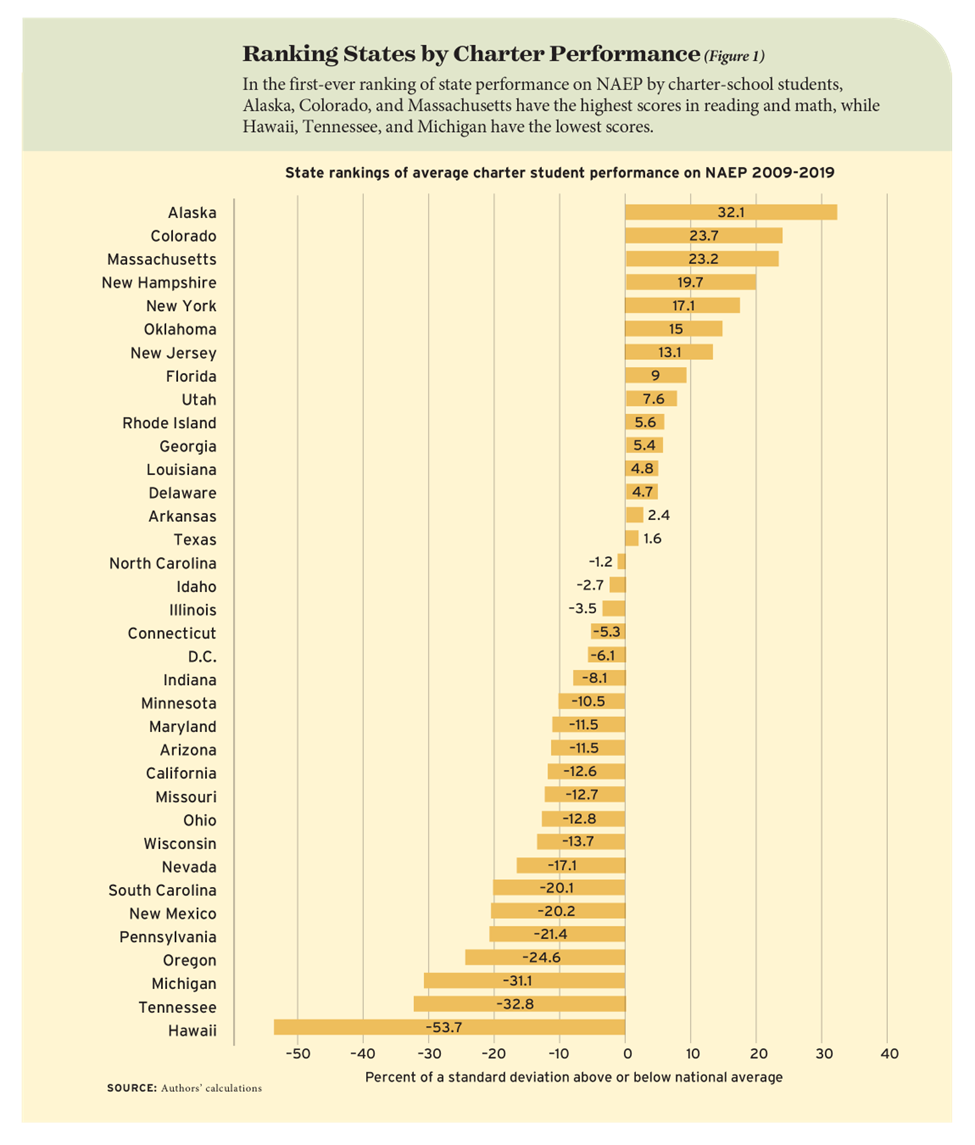
The Nation’s Charter Report Card | Peterson, Shakeel | First-ever state ranking of charter student performance on the National Assessment of Educational Progress, based on student performance in reading and math on the National Assessment of Educational Progress (NAEP), between 2009 and 2019. These rankings, created at Harvard University, are adjusted for the age of the charter school and for individual students’ background characteristics. They are based on representative samples of charter-school students in grades 4 and 8 and cover 35 states and Washington, D.C. They also estimate the association between student achievement and various charter laws and characteristics. (See also published article.)
Why does education matter in climate action? Evidence and mechanisms from China’s higher education expansion in the late 1990s | Wu, Sun, Jiang | Exploiting an exogenous shock from a centrally devised, nationwide higher education expansion in China in the late 1990s and followed by a surge in the college-educated labor in job markets in the early 2000s, a difference-in-differences strategy and carbon satellite datasets are used to empirically estimate the impact and mechanisms of increases in human capital investment on carbon emission intensity. Regions that are most human-capital-dependent experience a larger decline of carbon emission intensity compared with that of regions with the least after the policy came into force.
 Education, economics and public policy