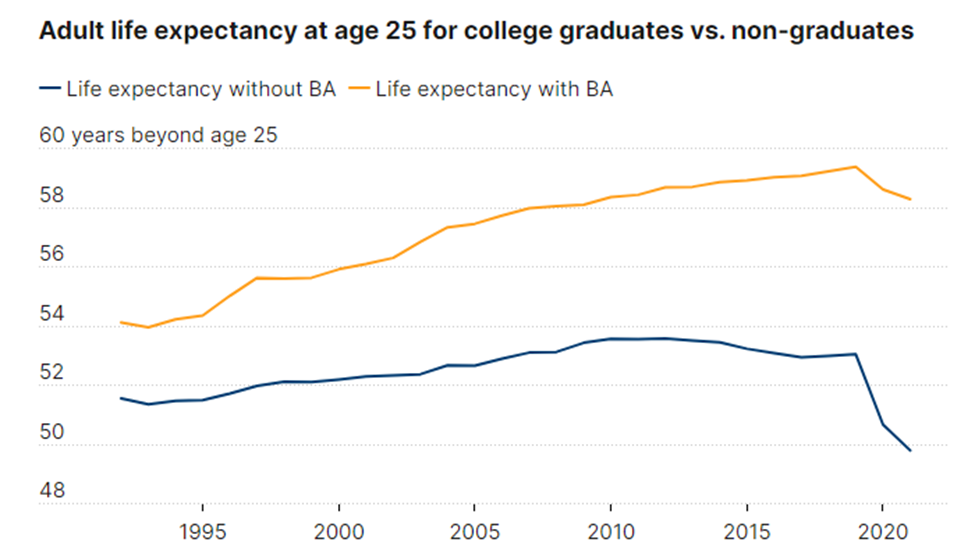
Education Increases Life Expectancy | (News and Research 357)
University education extends life expectancy | Case, Deaton | From 1992 to 2010, both college graduates and non-graduates saw falling mortality, but with greater improvements for the more educated; from 2010 to 2019, mortality continued to fall for those with a BA while rising for those without; during the COVID pandemic, mortality rose for both groups, but markedly more rapidly for the less educated.
Measuring Transformative Learning Gains: Key Findings from an RCT of Luminos’ Liberia Program | The RCT confirms that children make dramatic learning gains during the program. In the 2022-23 school year, Luminos students read three times more words per minute (WPM) and showed a two-times increase in addition and numeracy skills by the end of our one-year program, compared to the control group. Data from the RCT also shows that the Luminos program is one of only three education programs that is both transformational for children’s learning and cost-effective.
Schools and Society During the COVID-19 Pandemic: How Education Systems Changed and the Road Ahead | Reimers (ed.) | This open access book provides an analysis of the effects of the COVID-19 Pandemic on diverse education systems, and of the results of the policies adopted to sustain educational opportunities. Through a series of diverse national case studies, the book examines the preexisting fragilities and vulnerabilities in educational structures which shaped the nature of the varied responses, around the world, to teaching and learning during the worst crisis in public education in recent history.
Returns to Education Turns 50 | Submit a Manuscript to the Journal Education Economics for a Special Issue on the 50th Anniversary of the Returns to Education: An International Comparison | Manuscript deadline: 31 October 2023 | Special Issue Editor: Harry Patrinos, World Bank | Submit An Article | This year is the 50th anniversary of the publication of the book, Returns to Education: An International Comparison, by George Psacharopoulos (assisted by Keith Hinchliffe). Education Economics is publishing a special issue to mark this occasion and the contributions of Professor Psacharopoulos. The focus of this special issue is research on the returns to education. Research on international comparisons and /or returns to education in less developed economies are especially welcome.
Call for Papers: LESE (Lisbon Economics and Statistics of Education) Conference. Lisbon, Portugal, 18-19 January 2024. This 7th edition will continue a very successful tradition of getting together researchers, students, and education analysts, providing a forum to present methodological and applied research and to discuss quantitative results on education analysis. Submit extended abstracts or full papers until the 15th of October 2023 through the conference website: https://lese-conference.org/. The conference will include keynote speakers, roundtables, contributed parallel sessions, organized sessions, and a short course on the machine learning methods in education. The keynote talks will be given by: Simon Burgess (University of Bristol, UK) and Susan Dynarski (Harvard Graduate School of Education, USA. There will be two roundtables: What PIRLS 2021 and PISA 2022 Tell Us About Pandemic Learning Losses with Harry Anthony Patrinos (moderator, World Bank), Kristoff De Witte (KU Leuven), Maciej Jakubowski (University of Warsaw and Evidence Institute), and João Marôco (ISPA); After the Pandemic: What It Will Take to Improve National Education Systems with Nuno Crato (moderator, ISEG), Tommaso Agasisti (Polytechnic University of Milan), Noam Angrist (University of Oxford), and Carla Hearlemans (Maastricht University). Additionally, there is a short course on 17 January on Machine Learning in Education taught by Tommaso Agasisti (Polytechnic University of Milan).
 Education, economics and public policy