Global Learning Loss | (News and Research 352)
First estimates of global learning loss in student achievement using comparable reading scores | Jakubowski, Gajderowicz, Patrinos | At the World Bank, and with partners, we have been tracking the learning losses from COVID-19 for the past three years. At the start of the pandemic in 2020, we predicted learning losses and then in 2021 we reported on actual losses from several countries. But our latest analysis published in the journal Economics Letters shows that the losses are broader and deeper than we knew and confirms our commitment to helping countries recover the losses and reduce learning poverty. This latest analysis reveals that school closures led to student learning losses and that those losses are widespread. We found that international reading scores declined from 2016 to 2021 by more than a year of schooling. Students in schools that faced longer closures and lower-achieving students suffered larger declines. This analysis is more precise than previous estimates. We compared grade 4 score data from assessments of the Progress in International Reading Literacy Study (PIRLS) in 2001, 2006, 2011, 2016 and 2021 in 55 countries.
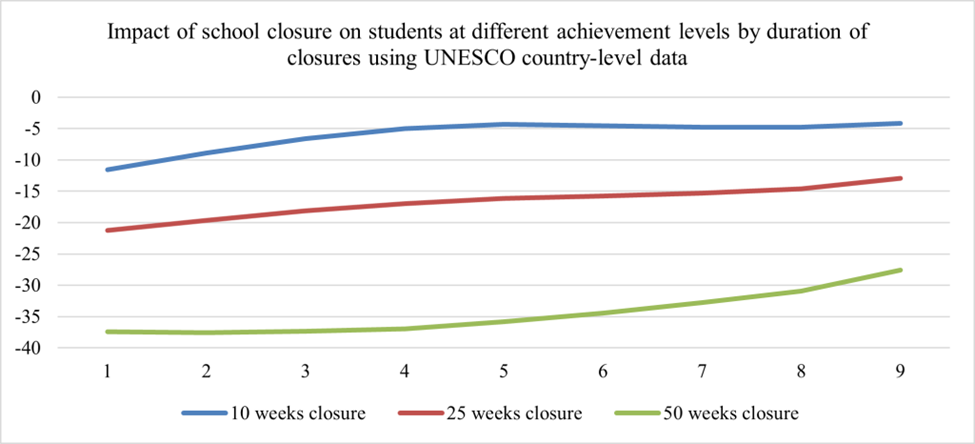
The decline in achievement was significantly larger for students in schools that faced longer closures
Countries with no closures in 2021 achieved results as predicted based on previous achievement
No differences for boys and girls
Lower-achieving students experienced much larger losses
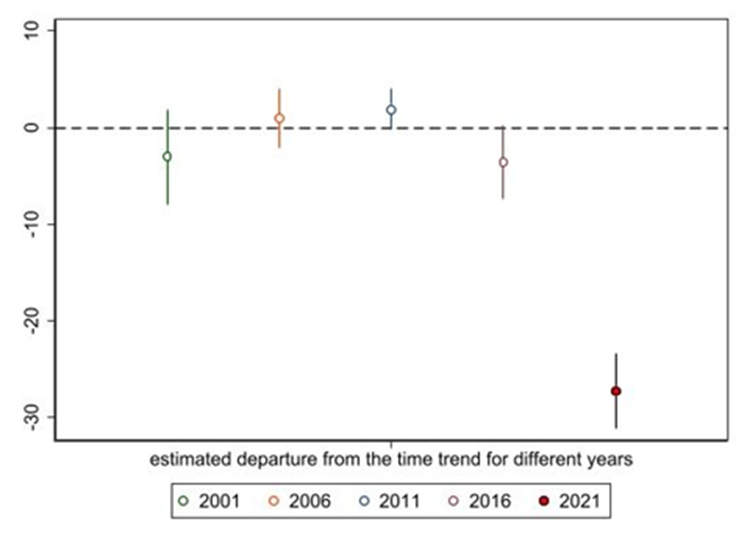
Departures from the time trend separately for each year of PIRLS assessment (95% confidence intervals)
**********
Bringing 13 million more children into school: Lessons from Punjab | Tahir, Geven | “In the heart of my village, a government school emerged as a blessing, helping us move ahead and become part of the workforce. Despite an academic atmosphere that may not have ranked as the best, its impact was profound as it helped me study at a university later, and today I work as a lecturer at a private university,” said Muhammad Tariq, a former student of a boy’s government high school in rural Punjab. Success stories like these from Pakistan are highlighted to demonstrate to policymakers that strategic investments in human development can pay off.
Enlightening communities and parents for improving student learning: Evidence from Niger | Kozuka | To investigate how communities can effectively utilize school resources, a randomized experiment was conducted in Niger. Communities and parents were provided with information about student learning together with school grants. The communities increased activities that enhanced student effort, and parents increased their contribution to school activities and engagement in children’s learning at home. Test scores improved by 0.43 standard deviations in math and 0.20 standard deviations in French and the impact was largest for the lowest-performing.
AI-powered teacher training: Promise or pitfall? | Wilichowski, Cobo | Low-and middle-income countries spend millions annually on teacher training. Despite these investments, training programs often fail to equip teachers with the content knowledge, pedagogical skills, and preparation needed to appropriately foster students’ foundational, socioemotional, and critical thinking skills. These weaknesses in training have led to an unfortunate reality in which many education systems fall short in adequately preparing and supporting teachers, resulting in a teaching force that lacks the content and pedagogical knowledge needed.
Invest in Youth, Transform Africa | Hassan, Kwakwa, Murthi | Africa is young, vibrant, and full of potential for rapid economic growth. All it requires is increased and sustainable investment in human capital. Africa’s young people are energetic and ambitious. As the most connected generation of Africans in history, they hold the key to unleashing greater productivity and propelling the economic trajectory of the continent – if they are healthy, educated, and skilled. The African Human Capital Heads of State Summit that took place last week brings this timely opportunity to the forefront.
An Analysis of COVID-19 Student Learning Loss | Patrinos, Vegas, Carter-Rau | in Oxford Research Encyclopedia of Economics and Finance: An analysis of recorded learning loss evidence documented since the beginning of the school closures between March 2020 and March 2022 found even more evidence of learning loss confirms that learning loss is real and significant, and continued to grow after the first year of the COVID-19 pandemic.
Curro grows profit as enrolments rise | Business Day |Private school group Curro is partnering with the Namibian Government Institutions Pension Fund, Ino Harith Capital, and the Development Bank of Namibia to develop two schools, without the cost of building, as a cheaper way to expand without investing heavily in the rest of Africa.
**********
Returns to Education Turns 50 |
Submit a Manuscript to the Journal Education Economics for a Special Issue on the 50th Anniversary of the Returns to Education: An International Comparison | Manuscript deadline: 31 October 2023 | Special Issue Editor: Harry Patrinos, World Bank | Submit An Article | This year is the 50th anniversary of the publication of the book, Returns to Education: An International Comparison, by George Psacharopoulos (assisted by Keith Hinchliffe). Education Economics is publishing a special issue to mark this occasion and the contributions of Professor Psacharopoulos. The focus of this special issue is research on the returns to education. Research on international comparisons and /or returns to education in less developed economies are especially welcome.
 Education, economics and public policy