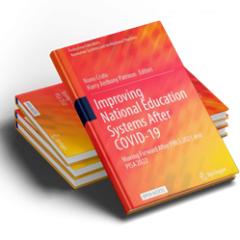
Global Learning Loss – Evidence from PIRLS | (News and Research 351)
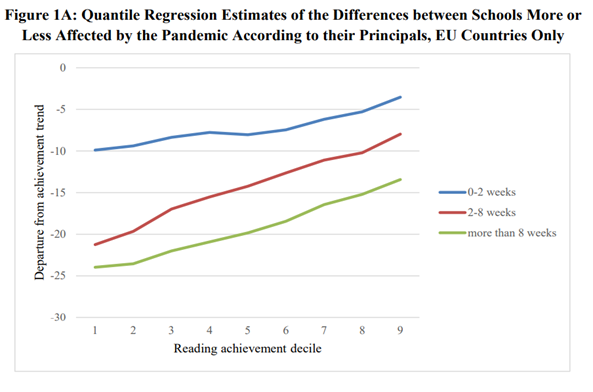
Global Learning Loss in Student Achievement: First Estimates using Comparable Reading Scores | Jakubowski, Gajderowicz, Patrinos | COVID-related educational loss equals more than a year of schooling. Learning losses are larger for those who faced relatively longer school closures. Lower-achieving students experienced much larger educational losses. The global impact of COVID-19 on student reading is assessed using comparable, international achievement tests (PIRLS). The effect of school closures (full and partial) on achievement is modeled by predicting the deviation of the most recent results from a linear trend using data from all rounds. Scores declined an average of 33 percent of a standard deviation, equivalent to more than a year of schooling.
• The COVID-related educational loss equals more than a year of schooling.
• Learning losses are larger for those who faced relatively longer school closures.
• Lower-achieving students experienced much larger educational losses.

Early effects of the COVID-19 lockdown on children in north-western Bangladesh | Makino, Shonchoy, Wahhaj | Using data collected through a structured telephone-based survey in north-western Bangladesh during the height of the pandemic, evidence on the effects of household specific shocks on rural children induced by the COVID-19 lockdowns is presented. The focus is on three child-related outcomes: time use of children during school closures, plans regarding children’s future schooling, and the incidence of child marriages. Respiratory illness and job loss experienced in the household lowered expectations of a child’s future school continuation and increased the probability of marriage-related discussions for girls. The return of a male migrant led to a reduction of children’s time spent doing paid work, while the return of a female migrant led to a reduction in children’s time spent caring for others and doing household chores. The findings offer a cautionary tale regarding the potential long-term effects of the pandemic and school closures on girls in developing countries.
Intergenerational mobility around the world: A new database | van der Weide, Lakner, Mahler, Narayan, Ramasubbaiah | Using individual data from over 400 household surveys, this paper compiles a global database of intergenerational mobility in education for 153 countries covering 97 percent of the world’s population. Intergenerational mobility in education is estimated to be lower in the average developing country than in the average high-income country. Children in the developing world have been less successful at surpassing their parents’ education, despite the lower levels of parental education. The poorer the country, the more likely it is that individuals born to parents who do not have an education lack the means to get an education. The world as a whole is estimated to be less mobile than the average country in it, which highlights the importance of the country in which one obtains his/her education.
Eton: Free sixth-form colleges plans approved by government | BBC News | Plans by world-renowned Eton College to open selective sixth-form centers in three English towns have been approved. The private school has teamed up with Star Academies to create the colleges in Dudley, Middlesbrough, and Oldham. It hopes to offer “transformative outcomes” for young people in disadvantaged areas. Eton, where many of the country’s prime ministers studied, will contribute about £1m per college annually on top of current funding levels. Each of the sixth-form colleges will admit 240 students a year and have 480 students across Year 12 and Year 13 when full. A spokesperson for Eton College and Star Academies said the aim was that most of its students would aspire to go to a top university and “this will be reflected in the GCSE results they will need for admission”…
**********
Returns to Education Turns 50 |
Submit a Manuscript to the Journal Education Economics for a Special Issue on the 50th Anniversary of the Returns to Education: An International Comparison | Manuscript deadline: 31 October 2023 | Special Issue Editor: Harry Patrinos, World Bank | Submit An Article | This year is the 50th anniversary of the publication of the book, Returns to Education: An International Comparison, by George Psacharopoulos (assisted by Keith Hinchliffe). Education Economics is publishing a special issue to mark this occasion and the contributions of Professor Psacharopoulos. The focus of this special issue is research on the returns to education. Research on international comparisons and /or returns to education in less developed economies are especially welcome.
 Education, economics and public policy