Back to the Short Cut | (News and Research 347)

Estimating Returns to Education: Back to the Short-Cut | Patrinos, Psacharopoulos |Estimates of the rate of return to investment in education have been the subject of an explosive literature in recent years papers. Most estimates come from the Mincerian earnings function. A less well-known method – the short-cut – offers an efficient means of quickly estimating returns with limited data. It has the added benefit of allowing for easy incorporation of public costs of schooling. Only needing grouped earnings by level of education, the short-cut method the method is becoming popular again, especially in cases where we lack detailed data, especially in developing countries. The short-cut offers an efficient means of quickly estimating returns with limited data. It is easy and quick. It allows for computing the returns to levels of education. The short-cut method has the advantage of making it easy to estimate social returns. Only tabulated mean earnings by level of education are needed. The short-cut method does explicitly what the earnings function, with dummy variables, does implicitly.
Flat Age-Earnings Profiles
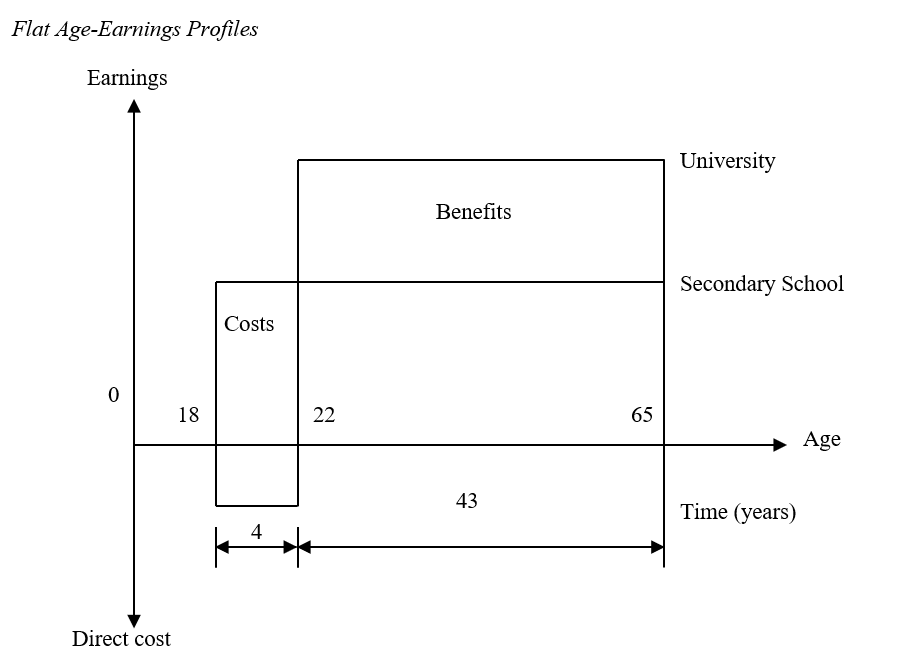
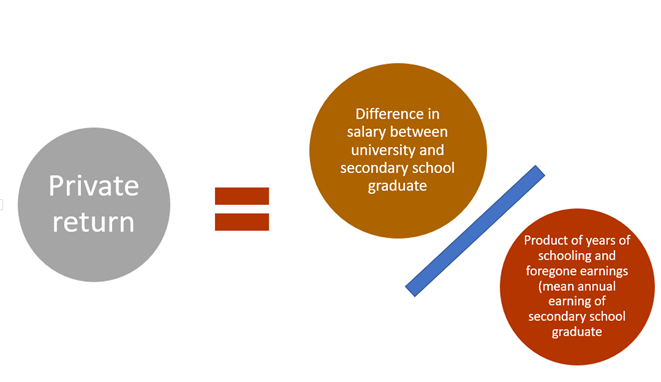
Taking a concrete example, the private returns to university education can be estimated by the formula:
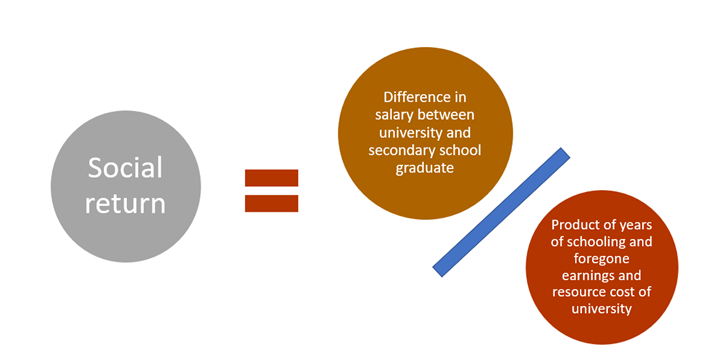
Other methods do not easily allow for the incorporation of educational costs. Despite its simplicity in defining returns to education, the short-cut method easily accommodates the integration of educational costs into the estimation of these returns:
For an illustration of the short-cut method using the U.S. Department of Education’s College Scorecard see this.
Educational Expansion and Shifting Private Returns to Education: Evidence from Mozambique | Jones, Pave Sohnesen, Trifkovic examine how returns to education have evolved in the context of post-conflict reconstruction and economic growth in Mozambique over the period 1996–2015. They show that private rates of return to education have declined at lower levels of schooling but remained stable and possibly even increased at the highest levels. Returns are increasingly convex in non-agricultural jobs but almost flat in agriculture. Using consumption expenditure data, as opposed to income data, allows estimation of returns for the entire labor market, not just the minority in formal sector jobs. Results are robust to a wide range of specifications, including use of a pseudo-panel.
Why Do Wages Grow Faster for Educated Workers? | The US college wage premium doubles over the life cycle, from 27 percent at age 25 to 60 percent at age 55. Using a panel survey of workers followed through age 60, Deming shows that growth in the college wage premium is primarily explained by occupational sorting. Shortly after graduating, workers with college degrees shift into professional, nonroutine occupations with much greater returns to tenure. Nearly 90 percent of life cycle wage growth occurs within rather than between jobs. To understand these patterns, Deming develops a model of human capital investment where workers differ in learning ability and jobs vary in complexity. Faster learners complete more education and sort into complex jobs with greater returns to investment. College acts as a gateway to professional occupations, which offer more opportunity for wage growth through on-the-job learning.
The Global Distribution of College Graduate Quality | Martellini, Schoellman, Sockin measure college graduate quality—the average human capital of a college’s graduates—for graduates from 2,800 colleges in 48 countries. Graduates of colleges in the richest countries have 50 percent more human capital than graduates of colleges in the poorest countries. Migration reinforces these differences: emigrants from poorer countries are highly positively selected on human capital. These stocks and flows matter for growth and development. College graduate quality predicts the share of a college’s students who become inventors, engage in entrepreneurship, and become top executives, both within and across countries.
Aggregate and Distributional Effects of ‘Free’ Secondary Schooling in the Developing World | Fujimoto, Lagakos, VanVuren analyze the aggregate and distributional effects of publicly funded merit-based (’free’) secondary schooling in the developing world. The analysis is based on an overlapping-generations model of human capital accumulation in which households face borrowing constraints that can lead to misallocation of talent in equilibrium. They estimate the model to match a randomized controlled trial that provided poor but talented children in Ghana with scholarships for secondary education. The model predicts that a nationwide free secondary schooling policy is largely redistributive in nature, with modest gains in GDP and average welfare. Policies that spend the same amount on improving education quality result in larger welfare gains for households of all income levels.
The Impact of the Transition and EU Membership on the Returns to Schooling in Europe | Patrinos, Rivera-Olvera IZA Discussion Paper No. 16326 (2023) | Countries across Eastern Europe and Central Asia are in their third decade of independence. What impact does this have on the skills premium and does accession to the European Union have an impact on the returns to education? The returns to education in 28 transition and 20 non-transition countries in Europe and Central Asia are analyzed using panel data analysis and difference-in-difference methods to estimate the impact of transition and EU accession. It is found that the transition from a centrally planned economy to a market economy increases the returns to schooling in post-socialist countries positively and significantly, especially through the EU accession channel.
**********
ECA Talk Returns to Education Turns 50 on March 29, 2023, Event Replay. Watch the discussion from earlier this week reassessing progress made on measuring the benefits of education 50 years after the publication of George Psacharopoulos’ pivotal study Returns to Education. Timestamps for remarks and panel discussions during the event replay are marked under the Agenda tab.

Submit a Manuscript to the Journal Education Economics for a Special Issue on the 50th Anniversary of the Returns to Education: An International Comparison | Manuscript deadline: 31 October 2023 | Special Issue Editor: Harry Patrinos, World Bank | Submit An Article | This year is the 50th anniversary of the publication of the book, Returns to Education: An International Comparison, by George Psacharopoulos (assisted by Keith Hinchliffe). Education Economics is publishing a special issue to mark this occasion and the contributions of Professor Psacharopoulos. The focus of this special issue is research on the returns to education. Research on international comparisons and /or returns to education in less developed economies are especially welcome.
 Education, economics and public policy