
The Untapped Potential of Education in the Battle against Climate Change | (News and Research 346)
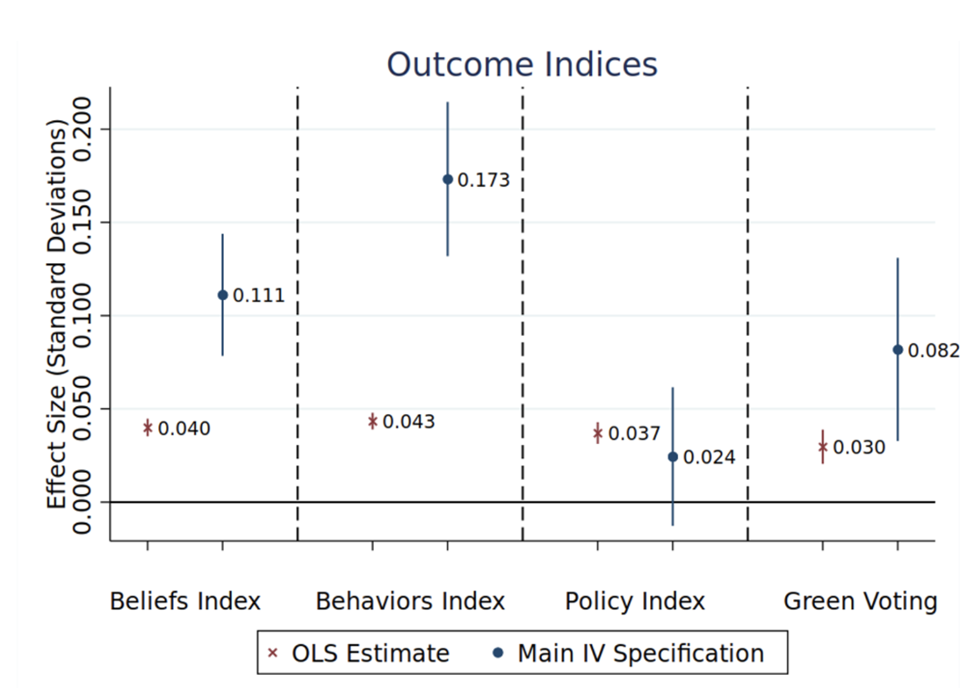
The untapped potential of education in the battle against climate change | People with more education are more likely to see climate change as a major threat. To identify whether education actually causes pro-climate beliefs, this column analyses changes in climate-related beliefs and behaviors following reforms of national compulsory-schooling laws in Europe that increased average educational attainment. Relative to the status quo, an additional year of education leads to increases of 4.5% in pro-climate beliefs, 7.8% in behaviors, 1.2% in policy preferences, and 28.2% in voting for green parties. Expanding general education should be added to the approaches considered in tackling climate change.
Building Better Formal TVET Systems | Technical and vocational education and training (TVET) systems in many low- and middle-income countries do not match skills and labor market needs and are unprepared to meet the large rise in demand for TVET in the coming years. In the context of rapidly changing labor markets and evolving skills needs due to globalization, technological progress, demographic transformation, and climate change, the need for well-performing TVET is even greater to ensure smooth job transitions. This is especially critical as global youth unemployment stands at 16 percent in 2022, much higher than the overall unemployment rate. These averages mask large disparities across countries, particularly in low- and middle-income countries. However, despite its high potential, training often falls short of expectations in low- and middle-income countries, says the report. This is largely due to difficulties facing learners, unsupported teachers, and weak incentives for training providers.
China’s Global Leap Winning friends by training workers is China’s new gambit | Washington Post |Vocational programs in 25 countries are part of Beijing’s softer approach to diplomacy.
Kazakhstan: Advance market reforms first, pour concrete later | Gill, Izvorski, Lall | “Perhaps the greatest driver of mobility—spatial, sectoral, and social—is good-quality education. Education quality is poor for a country on the doorstep of high-income. About 60 percent of 14-year-olds are functionally illiterate, the third highest percentage in Europe and Central Asia (ECA).”
Violent Discipline and Parental Behavior: Short- and Medium-term Effects of Virtual Parenting Support to Caregivers | Dinarte et al | Approximately 75% of children aged 2 to 4 worldwide are regularly subjected to violent discipline across the globe. This paper studies the impact of a virtually-delivered intervention on positive parenting practices in Jamaica. Short-term results indicate that the intervention improves caregiver knowledge (0.52 SD) and attitudes around violence (0.2 SD) and leads to meaningful changes in caregiver disciplining behaviors, with a 0.12 SD reduction in violence against children. Treatment children also experience fewer emotional problems (0.17 SD). Medium-term results (nine months later) show reductions in caregiver depression (0.12 SD), anxiety (0.16 SD), and parental stress (0.16 SD) for treatment caregivers. The virtual delivery has important scalable policy implications which could help decrease violence against children across the globe.
COVID-19 as an Opportunity to Build Resilient Education Systems Drawing Lessons from Five Countries in Eastern Europe and the South Caucasus | Chinen, de Hoyos | In response to the COVID-19 pandemic, education systems had to redeploy inputs typically used in schools to remote education. This significantly reduced average student learning, with disadvantaged students experiencing a disproportionately large decline. Not closing these learning losses will have long-lasting effects on productivity and economic growth and dampen social mobility. In the five Eastern European countries analyzed in this paper, not acquiring sufficient learning is not a challenge that began with the pandemic. Perhaps the pandemic and the attention it is bringing to students’ “learning loss” will create the political conditions to implement long-awaited education reforms to reduce the learning gaps and create better conditions for disadvantaged students, the core element of resilient education systems. This paper shows that using data to guide policy decisions, standardized tests as a diagnostic tool, and remediation policies should become permanent features of education systems. The pandemic pushed forward the use of technology in education. Using technology through online tutoring or Computer Assisted Learning can, when designed appropriately, improve students’ academic performance, socio-emotional skills, and psychological well-being.
**********
ECA Talk Returns to Education Turns 50 on March 29, 2023, Event Replay. Watch the discussion from earlier this week reassessing progress made on measuring the benefits of education 50 years after the publication of George Psacharopoulos’ pivotal study Returns to Education. Timestamps for remarks and panel discussions during the event replay are marked under the Agenda tab.

Submit a Manuscript to the Journal Education Economics for a Special Issue on the 50th Anniversary of the Returns to Education: An International Comparison | Manuscript deadline: 31 October 2023 | Special Issue Editor: Harry Patrinos, World Bank | Submit An Article | This year is the 50th anniversary of the publication of the book, Returns to Education: An International Comparison, by George Psacharopoulos (assisted by Keith Hinchliffe). Education Economics is publishing a special issue to mark this occasion and the contributions of Professor Psacharopoulos. The focus of this special issue is research on the returns to education. Research on international comparisons and /or returns to education in less developed economies are especially welcome.
 Education, economics and public policy